Ethereum Nears 2022 Lows as ETF Outflows and Governance Risks Bite
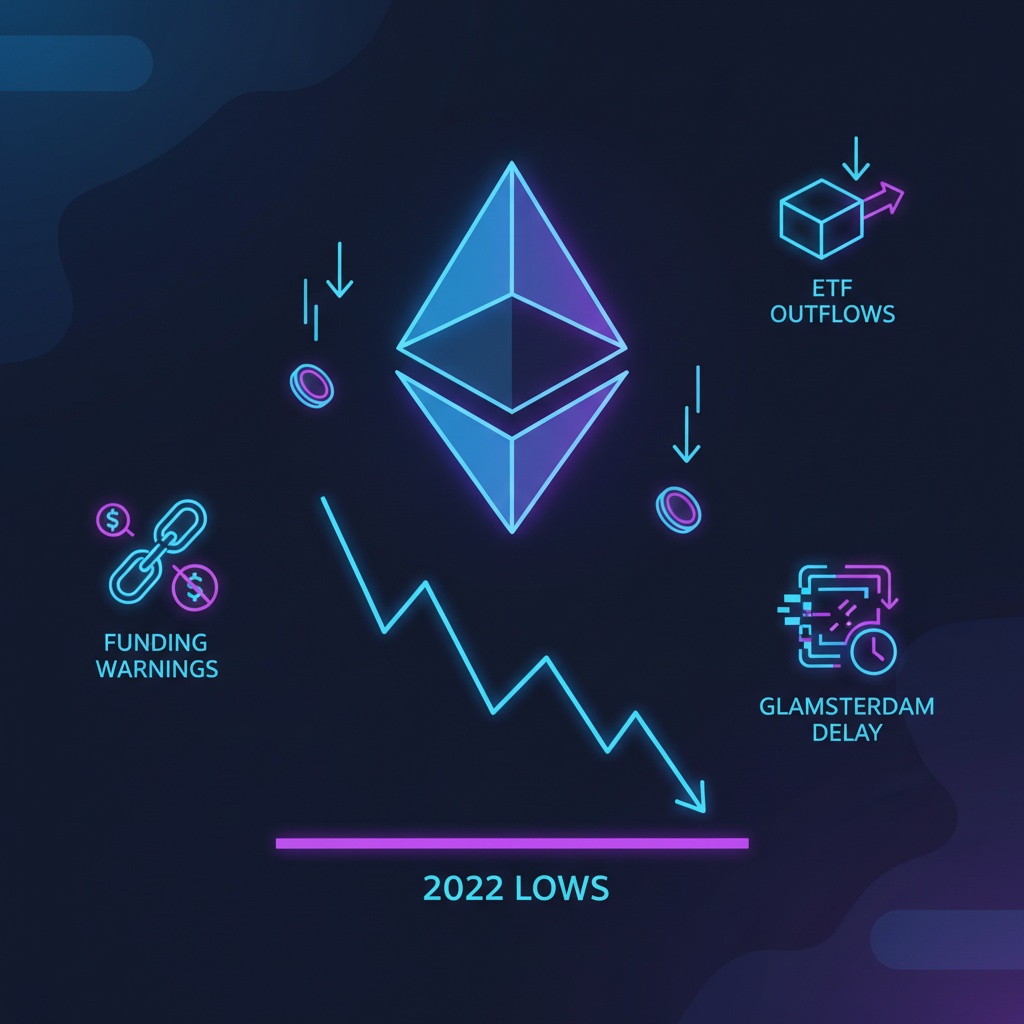
Ethereum is pinned in a tight trading band near the $1,560-$1,600 zone, with spot price around $1,580 and roughly 0.9% gains over the past 24 hours. That modest bounce masks a steeper drop of about 8-9% over the last week and places ETH near levels last seen during the 2022 bear phase. At the same time, U.S. spot Ethereum ETFs have logged seven straight sessions of net outflows, governance funding risks have moved into the spotlight after Ethereum Foundation cuts, and the much‑anticipated Glamsterdam upgrade has been pushed back, leaving Ethereum bulls with fewer near‑term catalysts as extreme fear dominates sentiment.
Price Action: Ethereum Stuck at Crucial Support
Market data shows Ethereum trading close to $1,580, with about a 0.89% move higher over the past day and a total market capitalization near $190.7 billion. That leaves ETH hovering around the lower edge of the $1,560-$1,600 band that analysts have flagged as a key support cluster.
Over the last week, ETH has dropped roughly 8-9%, retracing toward levels that recall the 2022 capitulation zone. Technical commentary from recent market analysis frames the $1,560-$1,600 region as a historically significant floor where prior downtrends have either stabilized or accelerated. A clean loss of this band would reinforce the current capitulation narrative and could open the way to deeper downside targets, particularly as broader crypto sentiment is locked in extreme fear.
The Crypto Fear and Greed Index currently sits near 12, squarely in the "Extreme Fear" category. In practice, that means traders are more inclined to sell into rallies, reduce leverage, and move to stablecoins or cash, while only the most risk‑tolerant participants are willing to accumulate ETH near current levels.
ETF Outflows: Seven Sessions of Selling Pressure
The most visible headwind for Ethereum price this week is a sustained run of outflows from U.S. spot Ethereum ETFs. Flow data from specialist trackers indicates:
- Seven consecutive trading sessions of net redemptions in spot ETH ETFs.
- Cumulative outflows around $273 million over that stretch as of the latest completed U.S. session.
This is not just noise. Spot ETFs are one of the primary vehicles through which institutions and larger retail accounts gain exposure to ETH. When these vehicles see persistent net outflows, it signals that bigger players are reducing exposure rather than adding risk, and it creates a structural seller in the market that spot buyers must absorb.
Recent coverage of Ethereum market structure has highlighted an emerging "flow deficit" where ETF redemptions, reduced fund holdings, and cautious derivatives positioning keep upside attempts short‑lived. That narrative matches this week’s tape: each modest bounce has run into renewed selling, while ETF outflows continue to leak capital out of the Ethereum complex.
For short‑term traders, the key takeaway is that until ETF flows stabilize or flip positive, ETH remains vulnerable to further pressure, especially if macro risk or crypto‑wide deleveraging coincides with another wave of redemptions.
Governance Shock: Ethereum Foundation Cuts and Funding Gap
Governance concerns join price and flows as a third major theme. In the latest development, the Ethereum Foundation reportedly cut staff by about 20% and trimmed its budget by approximately 40%. Prominent community figures have publicly warned that these reductions could leave a roughly $30 million annual funding gap for core protocol development if new funding streams are not identified.
For a network that prides itself on long‑term neutrality, credible decentralization, and robust public‑goods funding, this type of cut has both practical and psychological implications:
- Core development risk: Less funding and fewer full‑time contributors can slow protocol research and implementation, especially around scalability, security, and future upgrades.
- Perception risk: Traders may question whether Ethereum can maintain its pace of innovation relative to faster‑moving competitors that aggressively fund core teams and ecosystem growth.
- Governance narrative: The move adds fuel to ongoing debates about how Ethereum should fund itself and whether current grant and treasury models are sufficient in a prolonged down market.
In the short term, this governance shock feeds into the broader bearish story: price is under pressure, institutional flows are negative, and now the main funding body for the protocol is tightening belts. For some long‑term investors, this may be interpreted as a necessary efficiency step. For many traders, however, it is simply another reason to stay cautious.
Glamsterdam Upgrade Delayed: Fewer Near‑Term Catalysts
Another weight on sentiment is the delay of the Glamsterdam upgrade, which had previously been touted as a major 2026 catalyst for Ethereum’s roadmap. The upgrade is now expected in the second half of 2026, removing a key near‑term narrative that bulls had hoped to lean on during periods of price weakness.
While the exact feature set of Glamsterdam is still evolving across research and implementation discussions, it has generally been framed as part of Ethereum’s broader effort to refine its execution layer, improve efficiency for smart contracts, and continue the post‑Merge and post‑Dencun optimization path. Pushing this out further into the year does not change Ethereum’s long‑run trajectory, but it does mean traders have fewer concrete protocol milestones to position around over the next several months.
Without a clear upcoming upgrade, ETF inflow catalyst, or major macro tailwind, the market is left to trade mostly on flows, technicals, and risk appetite. In the current environment of extreme fear and persistent ETF outflows, that is a challenging mix for sustained upside.
Network Fundamentals: DeFi Dominance With Softer Activity
Despite these headwinds, Ethereum’s underlying network metrics still show why it remains central to the crypto ecosystem. On the decentralized finance side, Ethereum continues to control roughly 53-55% of total crypto DeFi total value locked (TVL), equivalent to about $43-45 billion. That level of economic activity underscores how deeply Ethereum is embedded in lending, trading, yield, and stablecoin infrastructure across the industry.
However, recent data also points to a cooling in usage at the margin. Daily active addresses on Ethereum have declined by around 12% over the past month. On‑chain analysts interpret this as a sign of softer organic usage, whether from retail users, arbitrage bots, or application‑level activity.
For anyone learning Ethereum basics, it is important to recognize that the value case for ETH is closely tied to the activity of its ecosystem:
- Users and developers interact with smart contracts for DeFi, NFTs, gaming, and infrastructure services, paying gas fees in ETH.
- High demand for block space and smart contract execution typically supports higher fee revenue and a stronger narrative for ETH as a productive asset.
- When active addresses and transaction counts decline, it signals reduced demand for block space, which can weigh on short‑term valuation even if core technology remains intact.
In other words, Ethereum still sits at the heart of crypto finance, but the current phase features that centrality combined with lower dynamic usage than in prior bull periods. This mix can maintain a baseline of value while failing to counteract sustained external selling, such as ETF outflows.
Key Levels and Scenarios: Support, Breakdown, and Recovery
Technical analysts are focused on a tight set of levels around current price. A simplified view looks like this:
| Level | Role | Implication if broken |
|---|---|---|
| $1,560 | Lower bound of key support band | Break below would reinforce capitulation narrative and open room toward prior bear‑market zones |
| $1,600 | Upper bound of support / immediate resistance | Consistent closes above would hint at stabilization and potential short‑covering |
| $1,750-$1,800 | Next overhead resistance area | Recovery into this zone would likely require calmer ETF flows and improved sentiment |
From here, market participants are broadly watching three scenarios:
- Support holds: ETH grinds sideways between $1,560 and $1,700 as ETF outflows slow and spot buyers gradually absorb supply. This would keep the 2022‑style capitulation risk in check.
- Support breaks: A decisive move below $1,560, especially on strong volume or in tandem with larger ETF redemptions, could trigger another wave of selling and push ETH closer to prior cycle lows, reinforcing the current extreme fear regime.
- Relief rally: If ETF flows stabilize, macro risk recedes, or a strong on‑chain narrative emerges, ETH could reclaim $1,700-$1,800. That would not end the broader downtrend but could reset positioning and reduce immediate stress.
FAQs
Is Ethereum still central to DeFi despite the price drop?
Yes. Ethereum still accounts for around 53-55% of total crypto DeFi TVL, roughly $43-45 billion, indicating it remains the primary settlement and execution layer for most major DeFi protocols. Price weakness and governance concerns have not yet translated into a wholesale rotation away from Ethereum in DeFi.
How do ETF outflows affect Ethereum’s spot price?
Spot ETFs are a key access point for institutional and larger retail investors. When these funds see consistent net outflows, they sell ETH to meet redemptions, creating structural selling pressure. If other buyers do not match this supply, spot prices often drift lower or struggle to sustain rallies.
What does the Ethereum Foundation funding gap mean for the network?
The reported 20% staff cut and 40% budget reduction, along with warnings of a potential $30 million annual funding gap, raise concerns that core protocol work could slow or become more dependent on alternative funding sources. This does not threaten the network’s immediate operation but could affect the pace and breadth of future upgrades.
What is the Glamsterdam upgrade, and why does its delay matter?
Glamsterdam is a planned Ethereum protocol upgrade expected to refine execution performance and support more efficient smart contracts as part of the network’s ongoing roadmap. Its delay into the second half of 2026 removes a near‑term technical catalyst that traders had hoped would help support valuations during this down phase.
How does on‑chain activity tie into Ethereum’s value?
Ethereum’s value is closely tied to how often users and applications interact with smart contracts and pay gas fees in ETH. A roughly 12% drop in daily active addresses over the past month suggests softer demand for block space, which can weigh on short‑term valuation even if long‑term fundamentals remain constructive.
What to Watch Next
Over the coming sessions, several indicators will be critical for Ethereum traders and investors:
- ETF flow data: Whether spot ETH ETFs continue to post net outflows or show signs of stabilization.
- Price reaction at $1,560-$1,600: How ETH behaves around this support band, including intraday liquidity and reaction to broader crypto moves.
- On‑chain metrics: Trends in daily active addresses, transaction counts, and DeFi usage that could either confirm or counter the current soft activity picture.
- Governance and funding updates: Any new proposals or initiatives to address the Ethereum Foundation’s funding gap and to strengthen long‑term protocol sustainability.
For now, Ethereum sits at a delicate intersection: near 2022‑style support levels, with ETF outflows, governance strains, and a delayed upgrade removing easy bullish narratives. Until flows improve and confidence returns, traders are likely to treat this area as a battleground between cautious accumulation and forced selling.
Disclaimer: This article is for informational purposes only and does not constitute financial, investment, or trading advice. Always conduct your own research and consider your risk tolerance before making any investment decisions.
This article is for informational purposes only and is not financial advice.