Ethereum ETFs Log 7th Day of Outflows as ETH Holds $1.55K Support
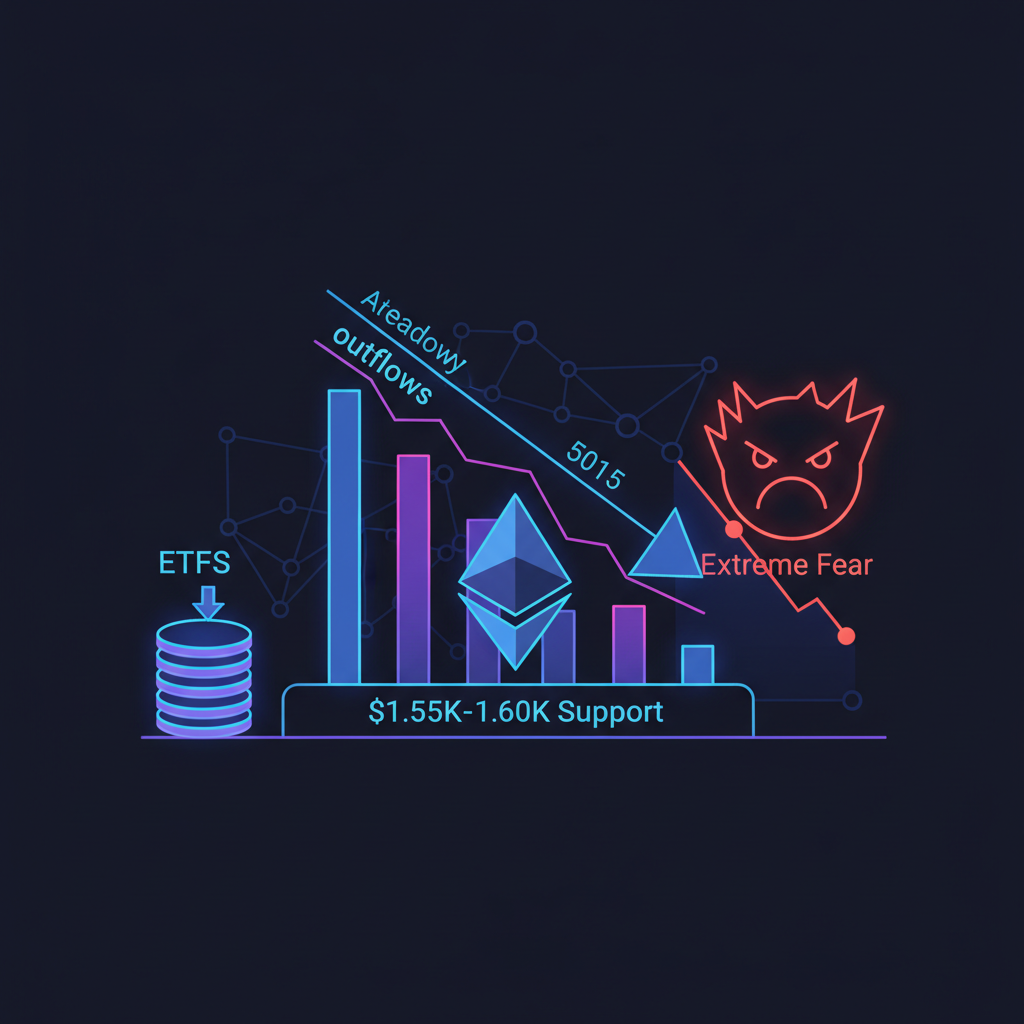
Ethereum is under sustained institutional selling pressure as U.S. spot Ethereum ETFs log a seventh consecutive day of net outflows, coinciding with ETH’s slide toward the critical 1,550 to 1,600 dollar support zone. With ETH trading around 1,566 dollars today, down about 0.9 percent over the past 24 hours and roughly 9 to 10 percent on the week, the market is grappling with whether this zone will hold as a durable bottom or give way to a deeper capitulation phase.
Against a backdrop of extreme fear, reflected in a Crypto Fear and Greed Index reading of 18, traders are watching ETF flows, technical levels, and on chain data for clues. The tension between institutional de risking, long term DeFi usage, and retail caution is shaping short term price risk and potential volatility around current levels.
Seven Straight Days of ETF Outflows: What It Means
Data from multiple ETF flow trackers show that U.S. spot Ethereum products have recorded seven consecutive trading sessions of net outflows, with combined withdrawals over this stretch in the region of 90 to 95 million dollars. While individual daily flow estimates vary by provider, the key signal is consistent: capital allocated to spot ETH ETFs has been leaving rather than entering for more than a week.
Several themes stand out in this outflow streak:
- Persistent risk off positioning: The seven day run of net redemptions suggests institutional investors are de risking ETH exposure through listed vehicles, likely in response to macro uncertainty, recent price weakness, and tighter financial conditions.
- Acceleration in the latest session: Flow data for the most recent U.S. trading session point to a noticeably larger single day withdrawal compared with prior days in the streak, reinforcing the sense that selling pressure is broad based rather than isolated.
- Cooling demand for ETF based ETH exposure: The sustained outflows, coming after periods of stronger inflows earlier in the year, indicate a shift in appetite for using ETFs as the preferred way to hold ETH in the near term.
For spot markets, this matters because ETF outflows generally require underlying ETH to be sold or redeemed. When this selling overlaps with a weak technical structure and fragile sentiment, downside moves can become self reinforcing. Traders are therefore treating ETF flows almost like another momentum indicator for ETH, especially around key levels.
Price Action: ETH Pressured Near 1,550-1,600 Dollar Support
Live market data show Ethereum trading around 1,566 dollars, with a 24 hour decline close to 0.9 percent and a weekly loss in the 9 to 10 percent range from recent levels above 1,700 dollars. This is a clear continuation of a short term downtrend that has broken through prior support zones and now centers on the 1,550 to 1,600 dollar band.
Technical analysts are focused on several features of the current setup:
- Critical horizontal support: The 1,550 to 1,600 dollar area lines up with prior consolidation zones and recent local lows, making it a psychologically important floor. A decisive break below it could open the door to tests closer to 1,500 dollars and beyond.
- Momentum in sell territory: Indicators such as MACD remain in bearish alignment, confirming the trend structure is still down, not neutral.
- Oversold conditions: Tools like Williams %R show ETHUSD in oversold territory. That combination of oversold readings with heavy ETF outflows often precedes either an aggressive flush lower or a sharp reflex bounce if sellers exhaust.
In practical terms, the market is now in a binary short term phase. If ETF outflows persist and macro conditions deteriorate further, a break below 1,550 dollars could trigger stop driven selling and renewed liquidations. If, instead, flows stabilize and buyers defend this band, the oversold state could fuel a rebound back toward the 1,650 to 1,700 dollar range.
On Chain Activity: Soft Speculation, Entrenched DeFi
On chain and network metrics add important context. Recent data show that daily active Ethereum addresses have declined by roughly 12 percent over the past month, a sign that speculative and transactional activity has cooled alongside price volatility. At the same time, Ethereum still accounts for more than 55 percent of total crypto total value locked, underscoring its dominance as the base layer for DeFi and smart contracts.
This divergence suggests:
- Lower short term participation: Fewer active addresses typically reflect reduced trading, NFT activity, and general on chain experimentation during periods of fear and falling prices.
- Sticky long term usage: The fact that Ethereum maintains a majority share of TVL indicates that core DeFi protocols, staking, and infrastructure remain deeply committed to the network, even if speculative flows ebb.
- Potential springboard: Historically, periods where speculative activity dips while foundational usage holds can set the stage for future recoveries once macro or regulatory overhangs ease.
For traders, the drop in daily active addresses aligns with the ETF outflow narrative: institutional and retail flows are cautious and selective. However, the underlying DeFi footprint provides a counterweight to more bearish long term interpretations, especially for those looking to store ETH with a multi year horizon rather than trade in and out.
Macro Headwinds and Governance Uncertainty
The broader environment continues to favor caution. Monetary policy remains tight, with policymakers signaling a willingness to keep rates elevated to anchor inflation. A strong dollar and choppy risk asset performance reduce the appeal of adding new crypto exposure for many institutions.
On the Ethereum specific side, ongoing debate about how to fund ecosystem development and public goods has created a modest governance overhang. Discussion around protocol level funding, staking reward dynamics, and the balance between core research and broader community priorities has contributed to an atmosphere of uncertainty. For ETF allocators who prize clarity and predictability, this can be another reason to trim exposure in the short run.
Put together, this macro and governance mix explains why ETF investors have been comfortable taking chips off the table, even if they remain structurally bullish over the long term. In extreme fear conditions, risk controls and de risked portfolios tend to trump long range narratives.
Storing ETH and Wallet Security In Volatile Conditions
While institutional flows are a key driver of short term price, individual holders still control the majority of ETH supply. For those choosing to store ETH through this volatility, wallet security and choice of custody model are critical.
Some practical considerations:
- Cold vs hot storage: Long term holders who plan to store ETH for months or years often prefer hardware wallets or other cold storage solutions. These keep private keys offline and significantly reduce exposure to hacking or malware.
- Non custodial control: Using non custodial wallets gives you direct ownership of your keys and assets. This removes exchange counterparty risk but requires careful key management and secure backups.
- Secure backups and access: Always maintain encrypted, offline backups of seed phrases or key files, and never share these with anyone. Phishing remains a major threat, especially when fear and fast moving price moves make people more susceptible to rushed decisions.
- Smart contract risk: If you store ETH in DeFi protocols to earn yield, review contract audits, protocol track record, and liquidation mechanics. In oversold markets and ETF driven downtrends, sharp price swings can stress DeFi systems and collateral values.
In periods like the current one, where ETF flows and macro stress raise the risk of abrupt moves, secure storage and robust wallet security are as important as market timing. Protecting the ETH you already hold is a prerequisite to any strategy, whether you are buying dips or simply waiting out the volatility.
Key Levels and Scenarios: Support, Resistance, and Risk
| Factor | Current Reading | Implication |
|---|---|---|
| Spot ETH price | About 1,566 dollars | Trades near critical support zone |
| Short term support | 1,550 to 1,600 dollars | Break below risks deeper selloff |
| Momentum indicators | MACD bearish, Williams %R oversold | Trend is down, but ripe for reflex bounce |
| ETF flows | Seven day outflow streak, about 95 million dollars | Institutional de risking, added downside pressure |
| Fear and Greed Index | 18, extreme fear | Sentiment deeply negative, but contrarian potential |
| On chain activity | Daily active addresses down ~12 percent, TVL share >55 percent | Speculative activity softer, core usage entrenched |
Two broad near term scenarios dominate trading desks:
- Support holds: ETF outflows slow, spot selling eases, and oversold technicals fuel a bounce from the 1,550 to 1,600 dollar band, potentially back toward 1,650 to 1,700 dollars. Extreme fear gradually retreats if price stabilizes.
- Support fails: Outflows persist or accelerate, macro data disappoint, and ETH slices through 1,550 dollars, triggering liquidations and a fast move closer to the 1,500 dollar area or lower before new buyers step in.
Which path plays out will largely depend on flows in the next few U.S. trading sessions and how macro markets behave. For now, traders are keeping risk tight around this zone, while longer term holders reassess allocation plans but often maintain or slowly add to positions when they store ETH with a multi year perspective.
What To Watch Next
Several catalysts and indicators are especially important over the coming days:
- Next ETF flow prints: Daily U.S. spot ETH ETF data will show whether the seven day outflow streak extends or finally breaks. A shift back to neutral or modest inflows would be a major signal for sentiment.
- Price behavior around 1,550 dollars: Intraday wicks, volume spikes, and order book depth near support will indicate whether buyers are committed to defending this level.
- Macro data and policy commentary: Any surprises in inflation numbers, employment data, or central bank communication could quickly alter risk appetite for crypto.
- On chain activity trends: Changes in daily active addresses, exchange balances, and DeFi TVL will help confirm whether this slowdown in speculative activity is stabilizing or worsening.
Given extreme fear readings and heavy outflows, the market is primed for larger than usual moves in either direction if new information hits. Active traders will likely keep tight stops and reduced leverage, while investors who store ETH for the long term may use weakness to rebalance gradually, always with a focus on wallet security and diversified custody.
FAQ
Are ETF outflows always bearish for ETH?
Net outflows from spot Ethereum ETFs typically mean underlying ETH is being redeemed or sold, which is short term bearish for price. However, outflows can also reflect rotation into other forms of exposure, such as direct spot holdings or staking, and their impact depends on size, duration, and overall market liquidity.
Why is the 1,550 to 1,600 dollar zone so important?
This band corresponds to recent local lows and prior consolidation ranges. It is a key psychological level that helps define the current trading structure. Holding above it keeps the short term downtrend from turning into a more severe capitulation, while a clean break below could invite more aggressive selling.
What does a Fear and Greed Index of 18 mean?
A reading of 18 sits firmly in the extreme fear range, indicating that market participants are highly risk averse. This often coincides with elevated volatility and selling pressure, but for patient investors it can also mark phases where future returns improve if they manage risk carefully.
How should I store ETH during volatile periods?
For long term holders, using hardware wallets or other cold storage options is generally considered more secure than keeping large balances on exchanges. Non custodial wallets give you full control over your keys, but they also require disciplined wallet security, secure backups, and caution against phishing attacks, especially when markets are stressed.
Does weaker on chain activity mean Ethereum is losing relevance?
Not necessarily. A drop in daily active addresses often reflects reduced speculative and transactional activity in the short term, while Ethereum’s continued dominance in overall DeFi TVL shows that core protocols and users remain committed to the network. Short term softness does not automatically imply long term decline.
Disclaimer: This article is for informational purposes only and does not constitute financial, investment, or trading advice. Always conduct your own research and consider your risk tolerance before buying, selling, or storing ETH or any other crypto asset.
This article is for informational purposes only and is not financial advice. Links marked “Sponsored” are affiliate/referral links.