Ethereum Holds Above $2,400 as Greed Index Hits 73, ETF Inflows Return
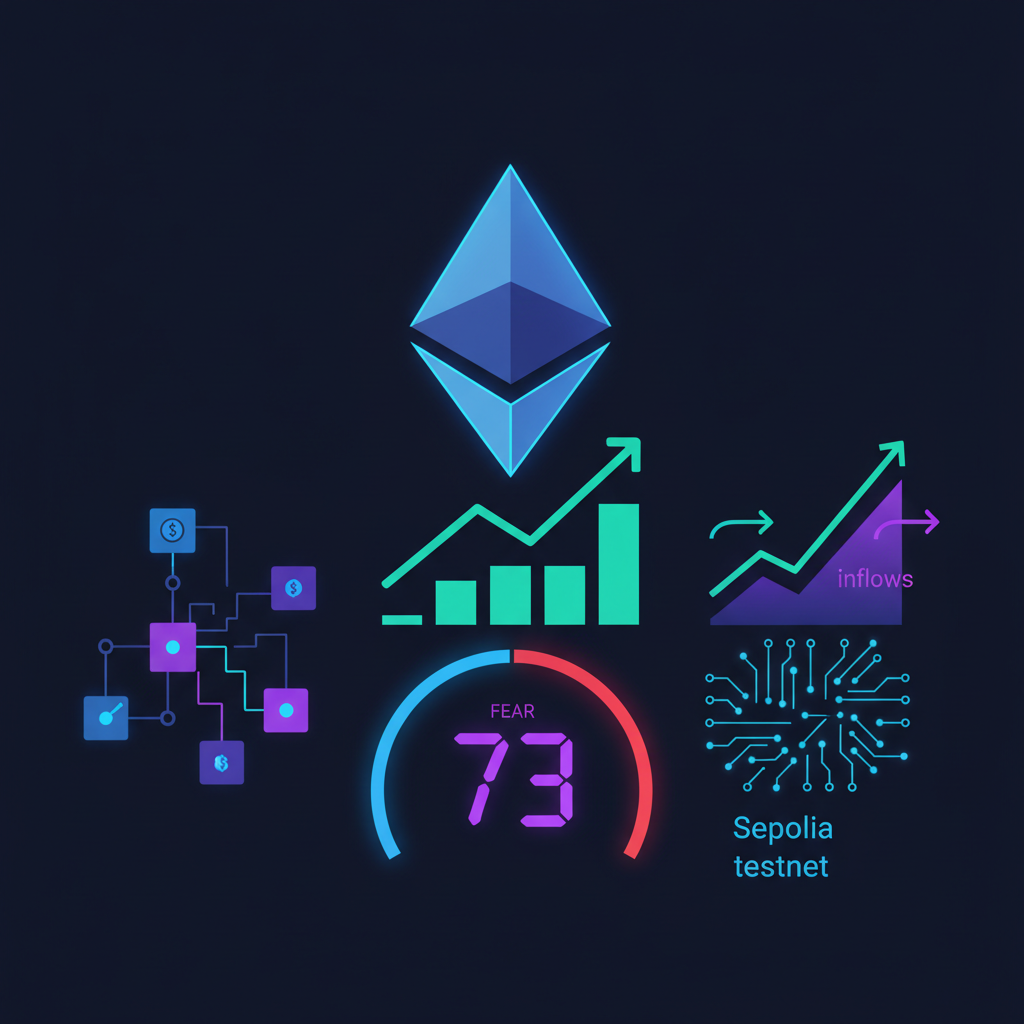
Ethereum started the trading week on solid footing, with the second-largest cryptocurrency by market capitalization holding firmly above the $2,400 psychological barrier. As of Monday, August 24, 2026, ETH traded at $2,457, reflecting a robust 24-hour gain of 2.90% and pushing total market capitalization to approximately $296.5 billion. The advance comes as the Crypto Fear and Greed Index climbed to 73, firmly in Greed territory, while spot Ethereum exchange-traded funds posted net inflows during the most recent trading session on Friday, August 21, 2026.
Technical Breakthrough Sustains Momentum
The decisive breakthrough above $2,400 materialized during weekend trading sessions and maintained momentum through Monday's Asian and European markets. This level has served as stubborn resistance throughout much of August, and the sustained breach suggests shifting momentum among market participants who had previously exhibited caution.
With the market cap hovering near $296.5 billion, Ethereum now targets the next cluster of resistance near $2,550 while defending $2,400 as fresh support. The 2.90% daily advance outpaced several major layer-one competitors, reinforcing ETH's relative strength within the digital asset ecosystem. Volume profiles indicate genuine buying interest rather than low-liquidity squeezes, with on-chain data showing increased activity across decentralized exchanges and institutional custodial wallets.
Technical indicators suggest the move has room to extend provided the $2,400 level holds through Tuesday's U.S. session. The 50-day moving average, currently trending toward $2,320, provides a secondary safety net for bulls should profit-taking emerge. Momentum oscillators remain elevated but not yet overbought on higher timeframes, suggesting the rally retains structural integrity despite the rapid ascent.
Institutional Flows Return to Spot ETFs
Institutional interest showed clear signs of revival during the latest U.S. trading session on Friday, August 21, 2026. Spot Ethereum ETFs recorded net inflows, reversing the outflow trends that had weighed on sentiment throughout the middle weeks of August. This shift marks a potential inflection point in institutional allocation strategies toward the asset.
The return of positive flows suggests that institutional investors are recalibrating positions ahead of potential autumn volatility, viewing the $2,400 level as an attractive accumulation zone. Unlike previous sessions characterized by systematic profit-taking and risk reduction across crypto portfolios, Friday's activity indicated renewed conviction in Ethereum's medium-term trajectory among regulated investment vehicles.
Analysts note that consistent ETF inflows often precede sustained price appreciation by several sessions, as these vehicles require underlying spot purchases to maintain net asset value alignment. The Friday inflows, coming after a week of sideways consolidation, provided the catalyst necessary to propel ETH through the $2,400 ceiling that had contained price action since early August.
Sentiment Enters Greed Territory
The Crypto Fear and Greed Index registered 73 on Monday, marking a notable shift from the neutral readings observed earlier this month. Readings above 70 typically signal heightened bullish sentiment and increased risk appetite, though they also warrant technical caution regarding potential overheating in the near term.
This composite metric aggregates data from market volatility, trading momentum, social media trends, and Bitcoin dominance to gauge emotional extremes among participants. The current reading suggests market participants are growing increasingly confident in continued upside potential, allocating capital more aggressively toward risk assets including Ethereum.
While elevated greed readings often correlate with strong price performance, experienced traders monitor for divergence signals. If price continues climbing while momentum indicators flatten, the conditions for a local correction increase. However, current funding rates across perpetual futures markets remain modest relative to previous greed cycles, suggesting the rally retains organic support rather than excessive leverage.
Sepolia Testnet and Infrastructure Progress
Beneath the surface price action, Ethereum's technical infrastructure continues methodical advancement. Developers remain focused on the Sepolia testnet, a critical staging environment for testing protocol upgrades before mainnet deployment. Recent validation rounds on Sepolia indicate steady progress toward upcoming network enhancements, with node operators and validators actively stress-testing execution layer changes.
The Sepolia testnet serves as the final proving ground for Ethereum Improvement Proposals, ensuring that modifications to the execution layer operate smoothly under realistic network conditions. Unlike the mainnet, where failures cost real economic value, Sepolia allows for aggressive experimentation with new transaction types and validation mechanisms.
Current activity on the testnet centers on optimizing block propagation and refining blob transaction handling, components essential for Ethereum's long-term scalability roadmap. Successful deployments on Sepolia typically precede mainnet upgrades by several weeks, providing developers confidence that the production network will handle new features without disruption. This steady technical progress underpins fundamental value propositions for ETH as the native asset securing the network.
Market Structure and Comparative Performance
| Asset/Level | Current Status | 24h Change |
|---|---|---|
| Ethereum (ETH) | $2,457 | +2.90% |
| Market Cap | $296.5 Billion | +2.85% |
| Fear and Greed Index | 73 (Greed) | +8 points |
| Immediate Resistance | $2,550 | Previous high |
| Key Support | $2,400 | Psychological level |
| Secondary Support | $2,320 | 50-day MA |
Ethereum's 2.90% gain outperformed the broader altcoin index during the same period, suggesting capital rotation favoring established blue-chip digital assets over speculative smaller tokens. This risk-on yet quality-focused behavior typically characterizes the early phases of sustained bull market advances rather than short-lived speculative pumps.
Frequently Asked Questions
What triggered Ethereum's break above $2,400?
The move resulted from a confluence of spot ETF inflows during Friday's session and improving macro sentiment across risk assets. The breakout occurred during weekend trading when reduced liquidity conditions often amplify directional moves. Sustained buying pressure through Monday's European session confirmed the validity of the move rather than treating it as a low-volume anomaly.
Does the Fear and Greed Index at 73 indicate a market top?
A reading of 73 indicates Greed, which historically correlates with strong price momentum but also increased probability of correction. While not an automatic sell signal, elevated readings suggest traders should remain vigilant for reversal patterns. The current reading reflects genuine optimism but has not reached the extreme levels sometimes associated with major cycle tops.
What do Friday's ETF inflows signify for ETH?
Friday's net inflows suggest institutional investors are returning to Ethereum exposure after a period of cautious outflows. Sustained inflows typically provide price support and validate the asset's investment thesis among traditional finance participants. These regulated vehicles require actual ETH purchases to back shares, creating direct spot market demand.
Why is the Sepolia testnet relevant to ETH investors?
Sepolia allows developers to test network upgrades without risking mainnet funds or stability. Successful testing on Sepolia precedes major network improvements that can enhance Ethereum's utility, efficiency, and long-term value proposition. While not directly impacting short-term price, robust testnet activity indicates healthy developer engagement and protocol maturation.
What to Watch Next
Market participants will focus on whether spot ETFs extend their inflow streak when U.S. markets resume Tuesday following the weekend. The ability to hold $2,400 as support through midweek will test the durability of the weekend breakout. A close above $2,500 would open the path toward $2,650, while failure to maintain current levels could trigger a retest of the $2,320 support zone.
Additionally, traders should monitor announcements regarding Sepolia testnet milestones or scheduling for upcoming network upgrades. Any acceleration in the development timeline could influence developer sentiment and broader market confidence in Ethereum's technical roadmap.
Macroeconomic factors remain critical, including Federal Reserve policy expectations and dollar strength. Should risk appetite persist across traditional equity markets, Ethereum may benefit from continued capital rotation into digital assets. Conversely, any sharp reversal in traditional risk assets could pressure ETH despite the current technical strength.
Disclaimer: This article is for informational purposes only and does not constitute financial, investment, or trading advice. Cryptocurrency markets are highly volatile and subject to rapid price swings. Always conduct your own research and consider your risk tolerance before making investment decisions. Past performance does not guarantee future results.
This article is for informational purposes only and is not financial advice. Links marked “Sponsored” are affiliate/referral links.