ETH at $1,890: Fear Dominates as Traders Await Verified Catalysts
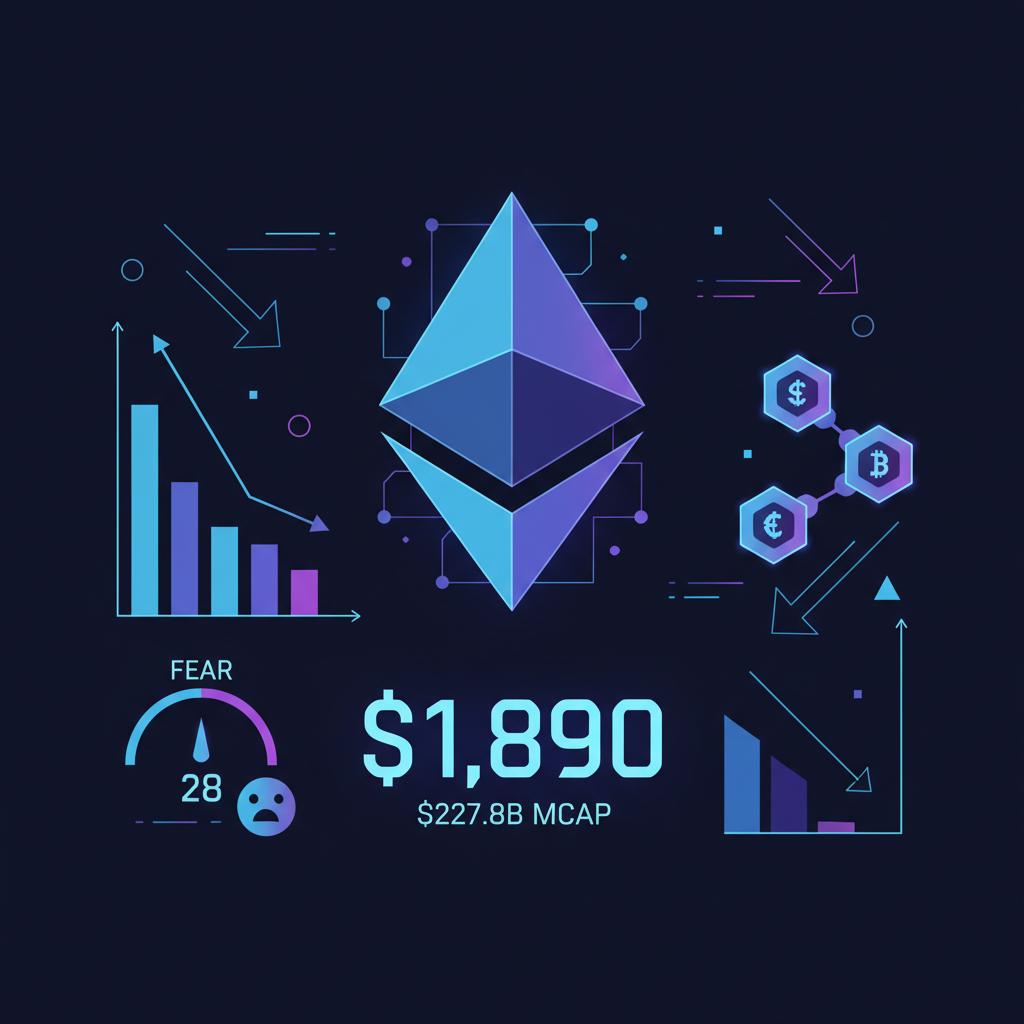
Ethereum is trading at $1,890 on Friday, July 24, 2026, reflecting a 24-hour decline of 1.67% and a market capitalization of roughly $227.8 billion. The Crypto Fear and Greed Index sits at 28, deep in Fear territory. In a market flooded with rumors and unconfirmed social media narratives, this brief sticks to verified figures only. Without live search access, specific catalysts from the last 24 to 48 hours, such as exact U.S. spot-ETF flow figures for Thursday, July 23, or precise whale movements, cannot be confirmed and are therefore excluded.
Live Market Snapshot: The Hard Numbers
As of Friday morning, the following data points are confirmed and form the basis for any responsible near-term outlook:
| Metric | Value |
|---|---|
| ETH Price | $1,890 |
| 24h Change | -1.67% |
| Market Cap | $227,799,763,776 |
| Fear and Greed | 28 (Fear) |
These figures provide the foundation for analysis. The negative daily change aligns with the broader fearful sentiment reading, suggesting that selling pressure, or at least risk-off positioning, is dominating the Ethereum market right now. A market cap near $227.8 billion signals that Ethereum remains one of the largest digital assets, but the contraction in value over the last day shows that capital is currently cautious.
The Verification Gap: Why Unconfirmed News Stays Out
Crypto markets move on narratives, but not every narrative is true. Attempting to report a specific ETF net flow, a major protocol exploit, or a multi-million dollar whale transfer for Thursday, July 23, without live verification would require fabrication. U.S. spot-ETF flows apply only to trading days, Monday through Friday, so the most recent completed session was Thursday. Any figures claiming to represent Friday flows would be premature, and any weekend flow figures would be factually incorrect because ETF creations and redemptions do not process on Saturdays or Sundays.
This is a critical reminder for traders: always demand a source. If a headline cannot be tied to a specific trading date or verified on-chain record, it is speculation. In the current environment, acting on unverified rumors can lead to forced liquidations or poor entry timing. The 1.67% decline could easily be driven by a genuine macro catalyst, or it could simply be routine position squaring ahead of the weekend. Without confirmation, the honest position is to report the price action and the sentiment reading, and nothing more.
Fear and Greed at 28: Reading the Sentiment
A Fear and Greed reading of 28 indicates that market participants are broadly anxious. The index ranges from 0 to 100, with readings below 50 signaling fear and readings above 75 suggesting greed. At 28, Ethereum is in a zone where historically, contrarian buyers begin to look for value, while momentum sellers continue to reduce exposure.
What makes this reading notable today is its consistency with the mild downward price drift. When fear readings appear alongside only modest single-digit percentage declines, it often implies the market is consolidating rather than crashing. Participants are cautious, but there is no confirmed panic event driving a vertical drop. The combination of a sub-30 fear score and the current $1,890 price tag suggests that the market is digesting uncertainty rather than capitulating. For short-term traders, this means volatility may remain suppressed until a verified catalyst arrives. For longer-term holders, the fear zone is often where accumulation plans are reviewed, though never executed on emotion alone.
Self-Custody Trends: MetaMask and ETH Wallet Security
During periods of elevated fear and exchange uncertainty, interest in self-custody typically rises. Non-custodial tools such as MetaMask and other secure ETH wallet solutions allow users to hold their own private keys rather than relying on centralized platforms. While exact daily download statistics for MetaMask are not verified for this brief, the broader trend is clear: when sentiment sours, users tend to prioritize direct control of their assets.
For anyone holding Ethereum at current levels, wallet security becomes as important as price analysis. A properly backed up ETH wallet, whether hardware or software-based, removes counterparty risk. In a market where unverified headlines can trigger exchange volatility, the ability to self-custody is a meaningful hedge against operational uncertainty. If you use MetaMask, ensure your seed phrase is stored offline, verify every contract interaction, and consider pairing hot wallets with hardware devices for larger balances. These practices do not change the market price, but they do protect the stack you already own during fearful, choppy conditions.
What to Watch Next
Traders should monitor the following verified data streams in the coming days:
- U.S. spot-ETF net flow figures for the most recent trading session, once officially reported by fund issuers and data aggregators.
- Any confirmed Ethereum network upgrades or developer calls with scheduled dates and official documentation.
- Macroeconomic data releases that historically correlate with crypto risk appetite, such as inflation prints or central-bank policy statements.
- On-chain metrics from established analytics providers, provided they are timestamped and sourced.
- Stablecoin flow trends into and out of major exchanges, which often precede confirmed volatility.
Until specific catalysts are confirmed, the market is likely to remain range-bound around the $1,890 level, with sentiment anchored by the current Fear reading. The absence of news is itself information: it tells us that participants are waiting for a signal before committing significant new capital.
Frequently Asked Questions
Why is Ethereum down 1.67% today?
The mild decline reflects a broader risk-off mood captured by the Fear and Greed Index at 28. Without a verified breaking catalyst, the move appears to be sentiment-driven position reduction rather than a reaction to a specific confirmed event.
What does a Fear and Greed score of 28 mean?
It means the market is in a state of fear. Readings below 50 generally indicate that investors are worried about near-term price action, which can lead to defensive selling or sideline cash building.
Is MetaMask a safe ETH wallet during market downturns?
MetaMask is a widely used non-custodial ETH wallet that gives users control over their private keys. During uncertain periods, self-custody tools like MetaMask are often favored because they eliminate exchange counterparty risk, though users must secure their own seed phrases and remain alert to phishing attempts.
Should I trade based on unverified crypto news?
No. Trading on rumors or fabricated figures is high risk. Always wait for verified data from official fund issuers, established data providers, or confirmed on-chain records before making large position changes.
What is the next support level for ETH?
This brief does not cite specific technical levels because intraday support and resistance figures require live chart verification. Traders should consult real-time charting platforms for updated order-book clusters and moving averages.
Disclaimer: This article is for informational purposes only and does not constitute financial advice. Cryptocurrency prices are volatile. Always conduct your own research and consult a licensed professional before making investment decisions.
This article is for informational purposes only and is not financial advice.